
Drawing Inspiration from National Santri Day
Published by Latifatussolikhah, 22 Oct, 2026
Est. 12 Minutes
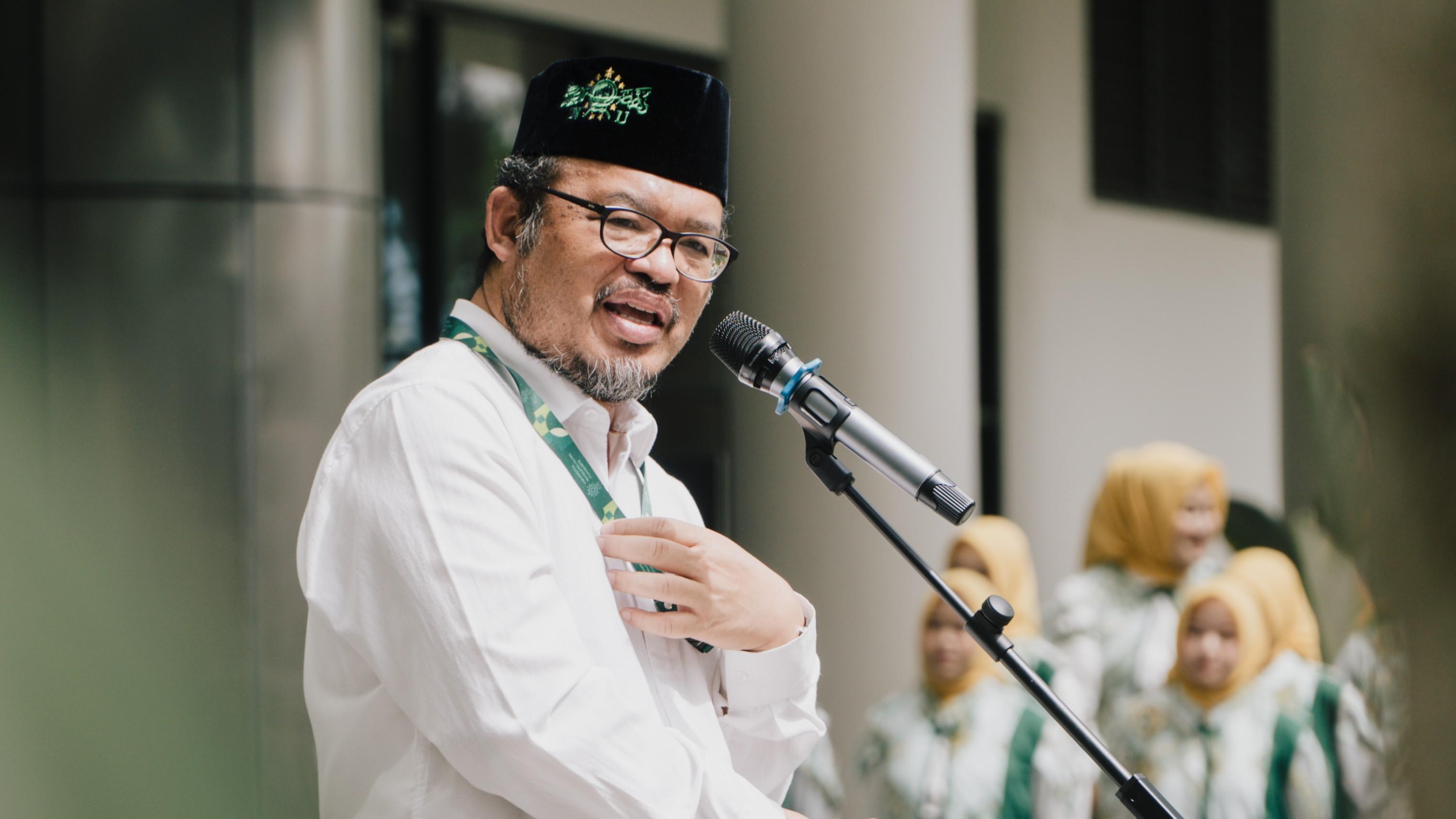
By Dr. Abdul Ghoffar, M.B.A.
[OPINION] National Santri Day, commemorated every October 22, is more than an occasion to remember the historical struggle of Islamic scholars and santri (students of Islamic boarding schools) in winning and defending Indonesia’s independence. It is also an opportunity to reflect on the noble values inherited from the pesantren tradition and explore their relevance to the nation’s present and future. If the spirit of the santri once burned brightly in the struggle to defend independence, that same spirit must now be rekindled to fill independence with meaningful work, service, and the greatest possible benefit for all Indonesians.
The question is, more than eight decades after independence, to what extent has freedom delivered prosperity, justice, and a dignified life for all citizens? And what values can we draw from the santri tradition to address the various challenges the nation continues to face?
Understanding the Meaning of Santri
In the general sense, santri refers to people who are currently studying or have previously studied at a pesantren, or Islamic boarding school. They study religious sciences, explore classical Islamic texts, cultivate good character, and develop habits grounded in Islamic values. A pesantren is not merely a place to acquire knowledge; it is also an environment for shaping character, where learning, exemplary conduct, discipline, and service are cultivated together.
In a broader sense, particularly within Nahdlatul Ulama (NU), the term santri also encompasses those who help preserve, nurture, and advance the values and aspirations of the organization, known as the jam'iyyah. In the tradition inherited from Hadratussyaikh KH. Hasyim Asy'ari, the relationship between kiai (Islamic scholars) and santri is built not only through learning at a pesantren but also through intellectual bonds, exemplary conduct, and shared struggle. Therefore, the spirit of being a santri can grow in anyone willing to serve religion, society, and the nation while upholding the values of goodness.
Meanwhile, in his book The Religion of Java (1960), Clifford Geertz used the categories of santri, abangan, and priyayi to examine the social and religious patterns of Javanese society. Within this framework, santri were described as a group relatively committed to Islamic practices and norms. This categorization was the result of an anthropological interpretation of society in its historical context, rather than an absolute standard for determining a person's Islamic faith or character.
From these various definitions, we can identify a common thread: santri is not merely a social identity but also a process of becoming a person who continues to learn, improve oneself, and strive to make religious values a guide for life.
Indeed, if being a santri is understood as a demand for perfection, some people may feel unworthy of the identity. Yet being a santri does not mean having overcome every shortcoming. Rather, it is a journey of continuous learning, self-improvement, character development, and drawing closer to Allah. What matters most is not believing oneself to be the best of people but remaining willing to grow into a better person.
In this sense, the spirit of the santri has ample room to grow and benefit anyone.
From Jihad Resolution to a Resolution of Service
The designation of National Santri Day through Presidential Decree No. 22 of 2015 represents the state’s recognition of the important role Islamic scholars and santri played in Indonesia’s struggle for independence. The choice of October 22 commemorates the Jihad Resolution proclaimed by Islamic scholars, with KH. Hasyim Asy'ari playing a significant role, on October 22, 1945.
Following the Proclamation of Independence on August 17, 1945, Indonesia was not yet entirely free from the threat of colonial rule. The arrival of Allied forces accompanied by the Netherlands Indies Civil Administration (NICA) posed a serious threat to the sovereignty of the newly established republic. In this situation, Islamic scholars took a firm position: independence had to be defended.
The Jihad Resolution affirmed the obligation to resist colonialism, particularly for Muslims in areas facing the threat of renewed occupation. The call inspired santri, kiai, and various armed resistance groups, including Hizbullah and Sabilillah, to defend independence. This spirit of resistance became one of the important forces accompanying the Battle of Surabaya on November 10, 1945.
The event offers a fundamental lesson: independence cannot be secured through physical courage alone. It also requires moral conviction, responsibility, and a willingness to place the common good above personal interests.
If the Jihad Resolution was an answer to threats against independence, the nation now needs a kind of resolution of service to address the challenges of the post-independence era. The adversaries we face today are different. They are no longer merely colonizers arriving with weapons but also corruption, injustice, poverty, ignorance, environmental degradation, and individualism that erodes social solidarity.
Today’s struggles may not always take place on a battlefield. They can unfold in classrooms, government offices, businesses, campuses, pesantren, laboratories, and any setting where people choose to work honestly, serve wholeheartedly, and put the public interest first.
Thus, drawing inspiration from National Santri Day means transforming historical courage into moral courage: the courage to speak the truth, reject corruption, defend the vulnerable, and improve circumstances even when change is difficult.
Character Development as a National Priority
After nearly a century of Indonesia’s journey as an independent nation, we have much to be grateful for. Infrastructure has expanded, access to education has widened, healthcare services continue to improve, and various economic sectors have grown. Yet appreciation for these achievements must not prevent us from acknowledging the problems that continue to affect our society.
Corruption remains a serious concern. Economic inequality shows that the benefits of development have not been distributed evenly. Poverty continues to limit some people’s opportunities to live decent lives. Justice is not always delivered as expected, while environmental degradation threatens the well-being of future generations.
These problems have complex causes, ranging from weaknesses in governance and unequal opportunities to economic structures and law enforcement. They cannot be resolved through moral appeals alone. Appropriate policies, strong institutions, effective oversight, and a genuine commitment to serving the public are essential.
Nevertheless, one foundation must not be overlooked: the character of the people who operate these systems.
Good regulations lose their effectiveness when those responsible for implementing them lack integrity. Welfare programs can be diverted when their administrators prioritize personal interests. Education, too, loses its meaning when success is measured only by academic grades, degrees, and employment prospects without cultivating honesty, compassion, and responsibility.
Character development, therefore, should be placed among the priorities of national development, rather than treated as a curricular supplement or a slogan for ceremonial occasions. Character determines how knowledge is used, power is exercised, wealth is managed, and progress is distributed.
Here, the pesantren tradition offers valuable lessons. For generations, pesantren have developed an approach to education that emphasizes not only mastery of knowledge but also daily habits, teachers’ exemplary conduct, responsibility, and service. These values, of course, are not exclusive to pesantren. Families, schools, other religious traditions, local wisdom, and various humanistic perspectives also contribute significantly to shaping national character.
The challenge is to bring this rich collection of values together in a consistent, inclusive character education movement that genuinely shapes everyday life.
Cultivating Santri Values in National Life
Several values associated with the santri tradition deserve to be developed as foundations for national character.
First, sincerity in service. Sincerity teaches us that work and good deeds should not be motivated solely by praise, popularity, or personal gain. In public life, this value can become the foundation of a strong service ethic. Public officials work for the people, teachers educate wholeheartedly, healthcare workers provide humane care, and every citizen contributes without always waiting for recognition. Sincerity does not mean neglecting professionalism or the right to fair compensation. Rather, it means ensuring that personal interests do not override the purpose of service.
Second, self-reliance. The pesantren tradition teaches the importance of taking responsibility for oneself, facing difficulties, and refusing to give up easily. Today, self-reliance must extend beyond the individual to intellectual, economic, and social spheres. An independent nation is one that can think critically, develop science and technology, strengthen productivity, and shape its own future without losing the ability to cooperate with other nations.
Third, simplicity. Simplicity does not glorify poverty or reject progress. It means placing needs in proper perspective, controlling desires, and refusing to make luxury the primary measure of success. In a society still facing inequality, simplicity reminds us that a person's success should also be measured by the benefits they bring to others. For those entrusted with public responsibilities, simplicity must be reflected in the responsible use of resources.
Fourth, integrity. Integrity is the alignment of words, beliefs, and actions. It is essential in confronting corruption, abuse of power, and various forms of dishonesty. Integrity grows when people uphold their principles even when they are not being watched, gain no immediate benefit, or face pressure. Integrity education cannot rely on advice alone; it must be demonstrated through the example set by parents, teachers, leaders, and public officials.
Fifth, discipline. The structured life of a pesantren teaches the importance of respecting time, fulfilling obligations, and maintaining consistency. Discipline bridges the gap between aspirations and achievement. A nation may have grand ideas, but it will struggle to progress if implementation remains weak. Discipline must be reflected in workplace culture, public services, budget management, law enforcement, and the public’s everyday efforts to maintain order and protect the environment.
Sixth, a commitment to lifelong learning. At heart, a santri is a seeker of knowledge who should never stop learning. Amid rapid technological, economic, and social change, Indonesia needs people who are open to new knowledge, willing to correct their mistakes, and capable of engaging in dialogue across differences. Respecting tradition does not mean closing oneself off to change. On the contrary, a living tradition is one that can engage with its times without abandoning its fundamental principles.
These six values complement one another. Sincerity gives service its purpose, self-reliance builds resilience, simplicity tempers desire, integrity safeguards honesty, discipline sustains consistency, and a commitment to learning opens the way to progress. When these values grow together, we can hope to nurture Indonesians who are not only intelligent and skilled but also morally responsible toward others.
Making Education a Collective Movement
Building national character is not a short-term undertaking. It cannot be achieved through seminars, slogans, or commemorations alone. Character develops through repetition, habituation, exemplary conduct, and a supportive environment.
Therefore, santri values should be integrated throughout the entire educational ecosystem: families, schools, pesantren, universities, workplaces, digital spaces, and government institutions. Character education must be reflected in how we manage differences, resolve conflicts, treat vulnerable people, maintain public facilities, and use power and resources.
We should also learn from countries that have successfully developed cultures of discipline, social trust, integrity, and public responsibility. Learning from them, however, does not mean copying their models wholesale. Every policy must be adapted to Indonesia’s context, cultural richness, religious values, social conditions, and development challenges.
Equally important, character education must be supported by a fair system. We cannot continually demand honesty from society if dishonesty is allowed to generate benefits. We cannot demand discipline if violations go unpunished. Nor can we teach simplicity if leaders set an example by displaying excessive and inappropriate luxury. Noble values will take firmer root when supported by consistent rules and an environment that rewards good conduct.
Character development and systemic reform must therefore proceed hand in hand. Good character strengthens institutions, while healthy institutions help shape the character of society.
From Commemoration to Change
Ultimately, the meaning of National Santri Day should not end with ceremonies, traditional santri attire, competitions, or expressions of respect for history. These activities can help preserve our collective memory, but the deeper meaning lies in our ability to translate the legacy of struggle into concrete action.
In 1945, Islamic scholars and santri demonstrated that patriotism is not merely a feeling but a willingness to take responsibility when the nation faces a threat. Today, patriotism must be expressed through a determined effort to build a more just society, eradicate corruption, reduce poverty, expand educational opportunities, protect nature, and ensure that the benefits of independence reach all Indonesians.
We do not have to become great heroes to continue this struggle. A teacher who educates with integrity, a public official who refuses corruption, an entrepreneur who treats workers fairly, a researcher who produces useful knowledge, and a citizen who protects the environment all have opportunities to work for the common good.
National Santri Day reminds us that independence is a trust that must continually be safeguarded. The Jihad Resolution has become an important part of the history of Indonesia’s struggle to defend the republic. Our challenge today is to carry that spirit forward through a resolution of service: building a nation of knowledgeable, ethical, self-reliant, disciplined, and principled people.
For the true measure of independence is not merely how long the nation has existed or how impressive its visible development may be. It is how far every citizen has the opportunity to live with dignity, receive justice, and enjoy prosperity.
Drawing inspiration from National Santri Day, therefore, means making noble values a force for transforming lives. It means not only remembering the courage of our predecessors but also carrying that courage forward in the ways our times demand: having the courage to be honest, work wholeheartedly, learn continuously, fight for justice, and bring benefits to as many people as possible.
That is where the spirit of the santri finds its most relevant meaning: upholding religion through good character, loving the homeland through service, and filling independence with meaningful work for a better future for Indonesia.
About the Author
Dr. Abdul Ghoffar, M.B.A., currently serves as Vice Rector for Pesantren Education and Social Transformation at Universitas Nahdlatul Ulama Yogyakarta. In addition to his academic work, he is known as a social activist and Islamic scholar. He also serves in the A’wan Syuriah (Advisory Council) of the Regional Board of Nahdlatul Ulama (PWNU) of the Special Region of Yogyakarta for the 2022–2027 term.
Editor: Latifah
Editorial Note: This article is the author's own work. The content, views, interpretations, and information presented are the sole responsibility of the author. The editorial team is not responsible for the views or opinions expressed in this article, except for editorial changes made for publication purposes.
Share
Related News

Imagination as a Power Generator: Literature and the Future of Energy
Published by Latifatussolikhah, 9 Oct, 2026 | Duration. 6 Minutes

When Bu Nyai Create Their Own Space
Published by Latifatussolikhah, 18 Sep, 2026 | Duration. 8 Minutes

Hospitality as a Distinctive Strength
Published by Latifatussolikhah, 18 Sep, 2026 | Duration. 6 Minutes
Popular News
Five PGSD UNU Jogja Alumni Pass Teacher Professional Education Program, Prepare to Become Future Teachers
Published by Latifatussolikhah, 1 Oct, 2026 | Duration. 4 Minutes
UNU Jogja Management Student Muhamad Chaerul Faalih Named 2nd Runner Up Putra Bahari DIY 2026
Published by Latifatussolikhah, 30 Sep, 2026 | Duration. 5 Minutes
UNU Jogja Students Pass P2MW Selection and Join KMI Expo XVII 2026
Published by Latifatussolikhah, 15 Sep, 2026 | Duration. 3 Minutes
Representing Yogyakarta, UNU Jogja Management Student Agung Putra Darmara Wins 2nd Honorable Mention at 2026 Indonesian Duta Genre
Published by Latifatussolikhah, 25 Sep, 2026 | Duration. 6 Minutes